
Plastic Tanks for Tilapia Breeding and Farming
As the world population expands we are finding an increasing need for sustainable farming of seafood. In order to keep pace with demand, aquaculture production must double the amount of food produced by 2030. One nutritious source of food, suitable for aquaculture is the farming of tilapia fish. The global harvest of tilapia now exceeds 800,000 metric tons. Carp are the most popular fish to farm – but tilapia comes second.
Other benefits include creating jobs needing skilled workers, and the safety of the farmed fish, together with the ecological benefits on our oceans and seas.
In order to produce high-quality, safe and nutritious tilapia we need the best environment for them to thrive and grow – and tank farming enables us to look after our fish with relative ease.
What is Aquaculture?
Aquaculture is the cultivation of plants or animals underwater. The water can be saltwater, freshwater or brackish. Fish, shellfish, oysters and molluscs can be bred in this manner for human consumption. Aquaculture can also be used for ornamental purposes.
What is Tilapia?
Tilapia is a tropical fish – but although it grows best in warm conditions the fish is tolerant of cooler water provided it is warmer than 13 degrees C. They can live in brackish water, are omnivorous and tolerate low feed quality, unlike some other species of fish.
They require a growth period of 4-5 months, more if you want bigger fish, and are usually harvested in Autumn. A good tank provides a safe and efficient way to farm tilapia.
There are several species or hybrids of Tilapia – and the one that tolerates cooler conditions best is the blue tilapia (Oreochromis aureus). Some of the blue tilapia hybrids grow faster, and since they are also sold as fish bait to anglers, there is a market for the smaller ones as well.
One advantage of tank culture is that you can control the population density of the fish and prevent them from increasing their numbers and thus slowing down their growth. One method of doing this is to breed only the males, thus eliminating reproduction. And since male tilapia grow to twice the size of females this is another advantage.
Physical characteristics of tilapia
Tilapia are members of the Cichlid family of fishes, with the characteristic interrupted lateral line. They are deep-bodied with long dorsal fins and wide vertical bars down the fry and fingerlings. They have spines on the dorsal and anal fins as well and around the pelvis.
Why breed tilapia in tanks?
Globally, around two-thirds of the fish we eat are farmed in controlled environments. As the cost of fishing in open water has increased, so people are searching for more cost-effective ways to meet the demand. And tough, durable aquaculture tanks fit the bill.
When the fish farmer uses tanks for his fish, he can control such things as temperature, waste management, pH and if necessary, treat fish diseases by dissolving the medicines in the water. Tank culture means he can produce high yields in a small space, it’s economical – and very practical.
The adult fish usually feed between three to six times a day. When the feed has not been eaten within about 15 minutes then the amount of feed needs to be reduced to prevent a build-up of toxins – and with a tank, this is easy to regulate.
Of course, it is essential to maintain a good quality of water for optimal results. None the less, tilapia are tolerant of low oxygen concentrations (less than 0.3 mg/L), they will survive when nitrate levels are higher than levels that kill many other types of fish, and tilapia are more resistant to disease than many other species.
What makes the perfect tank for breeding tilapia?
The tanks must be strong and long-lasting (and leak-proof).
The tanks must be made from non-toxic material that does not corrode. They should be easy to clean, and the inner surface should be smooth. This not only makes them easier to clean but also reduces resistance to flow – and a smooth surface is less likely to damage the fish than a rough one.
Different sizes for different stages of the fish culture are another benefit.
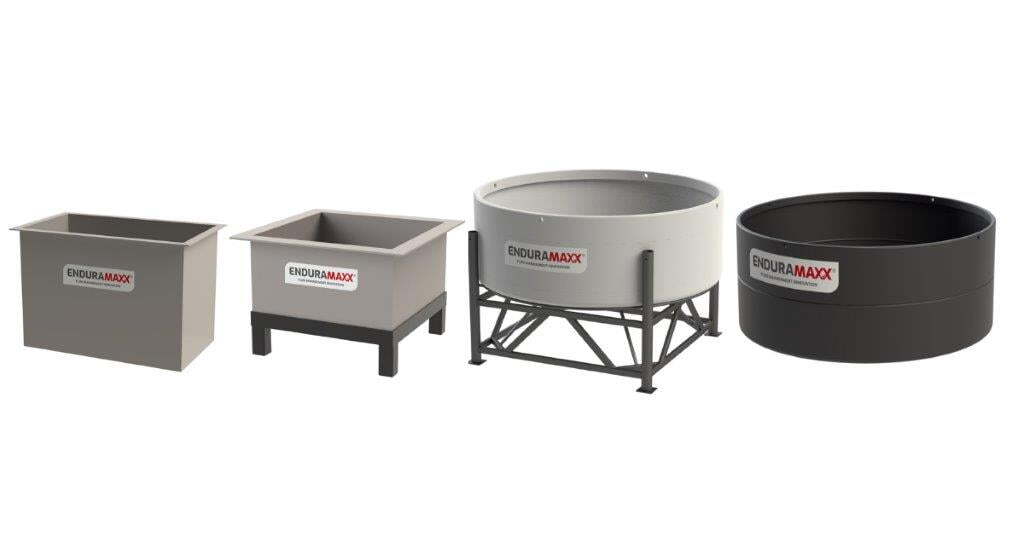
Enduramaxx plastic water tanks for fish
Our plastic tanks are rotationally moulded, for a smooth, seamless one-piece finish. They are tough, strong and come in various styles to suit your specific requirements.
We can offer the small, quarantine tanks and tanks for laboratory testing and for the early stage rearing at 110 litres – up to our circular stock-holding tanks with a 25,000-litre capacity. We even offer a variety of colours – green, black, blue and white.
Your tank can be provided with feet to lift them off the ground and make access easier, and working heights more comfortable. Or perhaps you would prefer the cone tanks that make cleaning so easy since all the water flows down to the centre of the cone? These tanks have a powder-coated frame that makes fitting pipework under the tank possible. The maximum capacity for our cone tanks is 25,000 litres.
View our Plastic Tanks for Tilapia Breeding and Farming here
Regulations for your aquaculture production business
There are many regulations to comply with before you set up as a fish farmer (i.e., “an aquaculture production business”) and afterward, this is to prevent the spread of disease. You will need to apply to the Fish Health Inspectorate (FHI) for permission. You can find a full list here.
You will need to keep records in the approved format and detail movements of fish in and out of your premises, the number of deaths and the results of your surveillance.
Enduramaxx Plastic Tanks for Aquaculture
The world population is increasing and the need for nutritious and easy to produce food is likewise increasing. Tilapia fish is a good source of protein, palatable and tolerant of conditions that other fish may tolerate less well.
Enduramaxx supply tanks plastic tanks for tilapia breeding and farming that enable the aquaculturist to create and maintain optimum condition for the health and growth of tilapia at a relatively low cost. We would be happy to discuss your needs further if you would like to give us a ring on 01778 302879
References
https://www.gov.uk/guidance/fish-shellfish-or-crustacean-farm-authorisation

Related Posts
Related Products
From £1,080.00 inc. VAT
£900.00 exc. VAT
From £1,344.00 inc. VAT
£1,120.00 exc. VAT
From £768.00 inc. VAT
£640.00 exc. VAT
£480.00 inc. VAT
£400.00 exc. VAT